Skip to content
Permanent Residency in Poland: How to Get PR in 2026
Two distinct paths to PR — Karta Stałego Pobytu vs EU Long-Term Resident. Requirements, documents, fees and the road to citizenship explained.
What is Permanent Residency (PR) in Poland?
Permanent residency grants you the right to live, work, and study in Poland indefinitely. Unlike the Temporary Residence Card (TRC), you never need to prove a "purpose of stay" again.
No work permits required — you work on the same terms as Polish citizens.
State healthcare, unemployment benefits, and family subsidies (e.g. 800+).
Right to study at state universities for free, on equal terms with Polish nationals.
PR is the final step before applying for a Polish passport and EU citizenship.
Two Paths to PR: Key Differences at a Glance
| Criteria | Karta Stałego Pobytu | EU Long-Term Resident |
|---|---|---|
| Primary basis | Polish roots, Karta Polaka, or marriage to a Polish citizen | 5 years of continuous legal residence in Poland |
| Language requirement | None (interview for roots applicants; certificate is a bonus) | Official B1 Polish language certificate — government exam only |
| Financial requirement | Usually none | Stable income + tax payments for the past 3 years (gap no bigger than 1 month) |
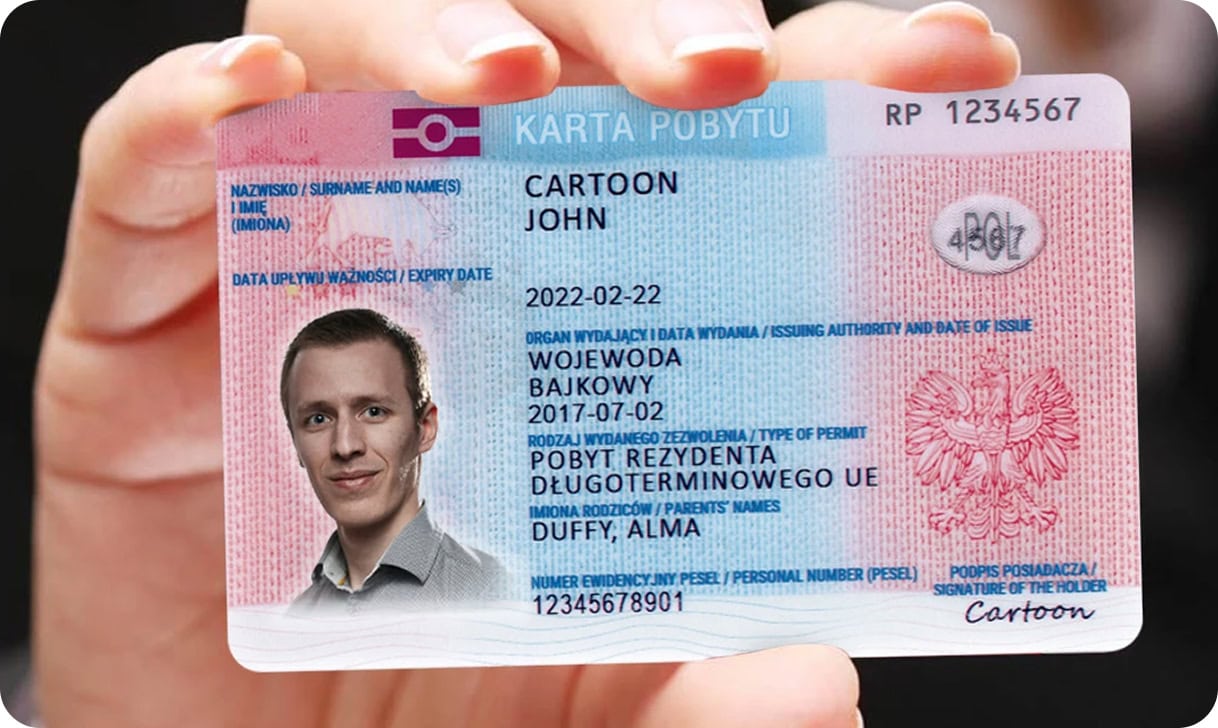
| Plastic card validity | 10 years | 5 years |
| Path to citizenship | After 1 year on PR | After 3 years on PR |
Path 1: Permanent Residence Permit (Karta Stałego Pobytu)
This path is primarily for those with a privileged connection to Poland through blood or marriage.
Who is Eligible?
You can apply immediately after arriving in Poland with the intention to settle. Exempt from the 640 PLN application fee.
You must prove that at least one parent/grandparent (or two great-grandparents) were of Polish nationality. Archival documents and certified translations required.
Married for at least 3 years + legally residing in Poland for at least 2 years on a TRC by Marriage.
Minor children born while the parent holds a PR or TRC are eligible to apply.
Required Documents
- ☑ Online application via MOS 2.0
- ☑ Proof of basis: original Karta Polaka, marriage certificate, or birth certificates of ancestors
- ☑ 1 digital photo (684×883 px, JPG format)
- ☑ Passport: original and copies of all pages
- ☑ Fee: 640 PLN (Karta Polaka holders are exempt)
Path 2: EU Long-Term Resident Status
The standard path for most international professionals who do not have Polish roots.
The 5-Year Continuous Stay Rule
No single trip outside of Poland can exceed 6 months.
Total time outside Poland over the 5-year period cannot exceed 10 months.
Only 50% of study years count toward the 5-year requirement.
Special rules apply: 18 months within Poland / 5 years within the EU; no single trip can exceed 12 months.
Language & Income Requirements
Must provide a state-issued B1 certificate from a government-recognised commission. University degrees taught in Polish or Polish high school diplomas are also accepted. Private school certificates are frequently rejected.
Must demonstrate stable and regular income for the 3 years immediately preceding the application. Tax payment gaps cannot exceed 1 month. Loss of income during processing can lead to rejection.
Step-by-Step PR Application Process
Gather all supporting documents: certified translations, PIT tax returns for 3 years, proof of continuous stay (rental agreements, old TRC cards), language certificate and health insurance.
Fill in the application (wniosek) online at mos.cudzoziemcy.gov.pl and sign with your Profil Zaufany (Trustable Profile).
You will visit the Urząd Wojewódzki to provide fingerprints. Only after this stage can your case be formally assigned to an inspector.
The office consults the Police and the Internal Security Agency (ABW) to verify you are not a security risk. Additional document requests may be sent by post — check your physical mailbox regularly.
In 2026, average waiting time for PR decisions is 6 to 12 months. After a positive decision, pay the card fee and collect your permanent residency plastic.
From Permanent Resident to Polish Citizen
Apply for citizenship after just 1 year of living in Poland on PR status. No language exam required at this stage if already passed earlier.
Apply for citizenship after 3 years of continuous stay on EU Resident status. A B1 certificate and stable income are key requirements.
Frequently Asked Questions (FAQ)
The status itself is granted indefinitely — you never lose it unless you commit a serious crime or leave Poland for a very long time. However, the biometric card must be replaced: every 10 years for Karta Stałego Pobytu and every 5 years for EU Long-Term Residents.
A Polish PR grants the right to work only in Poland. However, the EU Long-Term Resident status makes it significantly easier to obtain a residence and work permit in another EU country (like Germany or France) — you cannot simply move and start working without local authorisation.
For the EU Resident status, a loss of income during processing can lead to rejection — income must be "stable and regular." For those applying via Polish roots or Karta Polaka, employment status is generally not a factor.
Поделиться этой страницей